31st October 2023
Last updated: 8 May 2026 · By Luke Lv, Director, Lumira Studio
A good video has seven qualities you can usually spot within the first ten seconds: a clear purpose, considered lighting, clean audio, intentional composition, controlled pace, honest storytelling, and a finish that matches the brand. Get those right and the production budget becomes secondary. Get any of them wrong and no amount of polish saves the piece.
Why this matters: the data on video quality and trust
Across the brands we work with, the single most underrated input into video performance is production quality, and the data backs this up.
According to Wyzowl’s State of Video Marketing 2026 report:
- 89% of consumers say video quality directly impacts their trust in a brand
- 91% of businesses now use video marketing as part of their content strategy
- 82% of marketers report video delivers a strong ROI
In other words: video quality is no longer optional, and consumers can tell the difference. The question every marketing team should be asking is not “should we make video”, but “what makes the video good?”
Below are the seven qualities we look for, in priority order, when assessing whether a video will land.
1. Clear purpose and brief
A good video starts with a brief that answers three questions in one sentence: who is this for, what action do we want them to take, and what feeling should they leave with? If the brief takes a paragraph, the video usually wanders.
The clearest signal of a weak brief is a video that tries to do everything: explain the product, build the brand, drive demos, and hit three personas. Each of those is a different video. The strongest pieces we have worked on in the last 18 months committed to one job, and let everything else fall away.
What to ask yourself: if a viewer watches this once and remembers one thing, what is it?
2. Lighting that supports the subject
Lighting is the difference between footage that looks expensive and footage that looks like it was filmed in a meeting room. The principle is simple: light supports the subject, it does not draw attention to itself.
The two most common lighting mistakes we fix on rescues and re-edits:
- One harsh, flat overhead source. Office ceiling lights flatten faces, deepen under-eye shadows, and make skin tones inconsistent. A diffused key light at 30 to 45 degrees off-axis transforms the same subject.
- Mixed colour temperatures. Warm tungsten on the subject mixed with cool daylight from a window produces an unusable colour cast. Either match temperatures or commit to one source.
For most corporate work, three-point lighting (key, fill, back) on the subject with a controlled background is enough.
3. Clean, intentional audio
Audio is the quality most people underestimate, and the one most viewers notice fastest. Poor audio loses an audience in seconds. Bad picture is forgivable in a way that bad sound never is.
Three things separate good audio from bad:
- Microphone choice and placement. A lavalier or shotgun close to the subject beats a built-in camera mic at three metres every time.
- Room acoustics. Hard surfaces and high ceilings produce echo. Soft furnishings, carpet, or acoustic foam make the same room broadcast-ready.
- Levels and limiting. Audio peaking into distortion, or sitting too low to hear, both signal an amateur production. Aim for dialogue at -12dB to -6dB.
4. Intentional composition and framing
Composition is where craft becomes most visible. Strong composition has three properties: the subject is placed deliberately, the headroom is controlled, and the eye knows where to go.
The fastest way to spot weak composition is to watch a video on mute. If your eye does not immediately settle, the framing is doing too much work for too little payoff.
For talking-head and interview content, the eye-line should sit roughly one third from the top of the frame, with the subject’s gaze leading into negative space, not into the edge.
5. Controlled pace and edit rhythm
Edit rhythm is the part most clients do not have language for, but everyone feels. A good edit gives the viewer just enough time on each shot. Long enough to absorb it, short enough to keep moving.
The data on pacing is unambiguous. HubSpot’s 2026 marketing statistics show videos under one minute average a 50% engagement rate, while videos over 60 minutes drop to 17%. Length is not the only factor, but pace within the duration matters more than people realise.
A practical rule we use on edits: every cut should answer the question “what does this shot give me that the last one did not?” If you cannot answer, the cut is decoration and should come out.
6. Honest storytelling
The hardest quality to fake is honesty. Audiences read body language, vocal tone, and editorial choices fast. A polished video carrying an over-rehearsed message does worse than a less polished video saying something true.
This is why testimonial work, case studies, and founder stories, when treated with care, outperform glossy brand reels for most B2B audiences. Wyzowl’s data shows 84% of consumers want to see more video from brands in 2026, but the appetite is for content that feels like it came from a person, not a committee.
The practical version: if a script makes the subject uncomfortable to read, rewrite the script to match the way they would actually say it. Then film.
7. Brand-consistent finish
The final 5% of a video, colour grade, typography, logo treatment, end card, is where amateur and professional work most visibly diverge. A piece can be well-shot, well-edited, well-acted, and still feel cheap if the finish does not match the brand.
A consistent finish means:
- Colour grade aligned with the brand palette
- Typography from the same family the brand uses elsewhere
- Logo treatment matching how it appears on the website and email signatures
- A consistent end-card framework across the brand’s video library
Brand consistency on every surface, especially the small ones, is what separates considered businesses from the rest. We make the same case in our free email signature generator: those small surfaces matter more than they look.
Amateur vs professional video at a glance
| Element | Amateur | Professional |
|---|---|---|
| Lighting | Single overhead source, mixed colour temperatures | Three-point setup, matched colour temps, controlled fall-off |
| Audio | Camera mic, no acoustic treatment, unbalanced levels | Dedicated mic close to subject, treated room, levels at -12 to -6dB |
| Composition | Subject centred, no consideration of headroom | Rule-of-thirds applied, intentional negative space, controlled eye-line |
| Edit pace | Long takes, no rhythm, decoration cuts | Every cut earns its place, pace responds to content |
| Story | Multiple messages competing | One job, executed precisely |
| Finish | Default colour, generic typography, mismatched end card | Brand-aligned colour grade, brand typography, consistent end card |
How to assess a video against these qualities
A quick self-audit: watch the video twice. First with the sound off, then with the picture off.
- Sound off: is the composition working? Does your eye settle? Does the pace flow?
- Picture off: is the audio clean? Can you follow the message without visuals? Do levels sit comfortably?
If a video passes both, it has the structural qualities of professional work. The remaining 5%, the colour, type, and brand treatment, is the polish layer.
Frequently asked questions
What is the most important quality of a good video?
Audio quality. Viewers forgive an imperfect picture far more than imperfect sound. A clear voice, treated room, and balanced levels do more for perceived production value than expensive cameras.
How do I improve the quality of my videos without buying expensive equipment?
In order of impact: improve your lighting (one diffused key light off-axis), upgrade your microphone (a £100 lavalier outperforms most built-in camera mics), treat your filming environment (carpet, soft furnishings, or acoustic panels), and tighten your script before you shoot.
What length should a marketing video be?
Most marketing video should sit under 90 seconds for paid social, under three minutes for landing pages, and under six minutes for educational content. Engagement rates drop sharply past these thresholds: under-one-minute video averages 50% engagement, dropping to 17% above 60 minutes per HubSpot’s 2026 data.
How can I tell if my video is on-brand?
Place a still from your video next to your website, your pitch deck, and your email signature. If the colours, typography, and visual tone do not sit naturally together, the video is off-brand.
What makes a video professional rather than amateur?
Three things, in order: intentional lighting, clean audio, and a consistent finish (colour grade, typography, brand treatment). Equipment matters less than the deliberate use of these three elements.
What this means for your next video
If your team is briefing a video right now, here is the short version:
- Define one job for the video. One action, one audience, one feeling.
- Spend 50% of the budget on the things that compound: script, lighting, audio. These are the quality drivers.
- Treat the finish (colour, type, end card) as a brand requirement, not an after-effect.
Get the first three right and most of the rest follows.
From the studio
A year of content, filmed in one day.
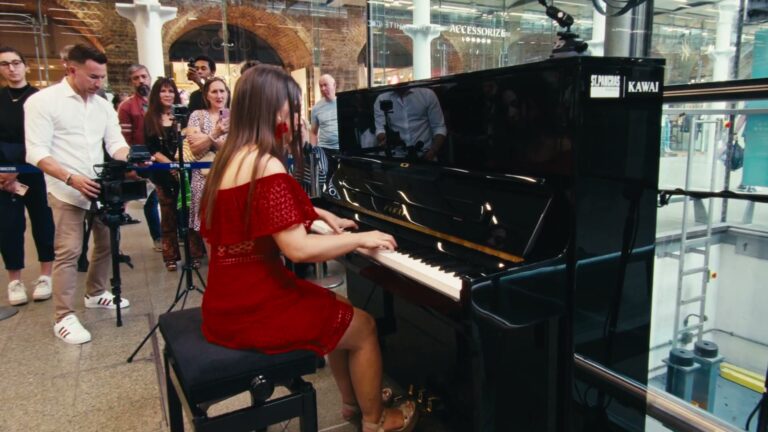
Kawai UK needed 104 films and had the budget for one filming day. We wrote every script first, then filmed all 104 in eight rooms with two crews.